

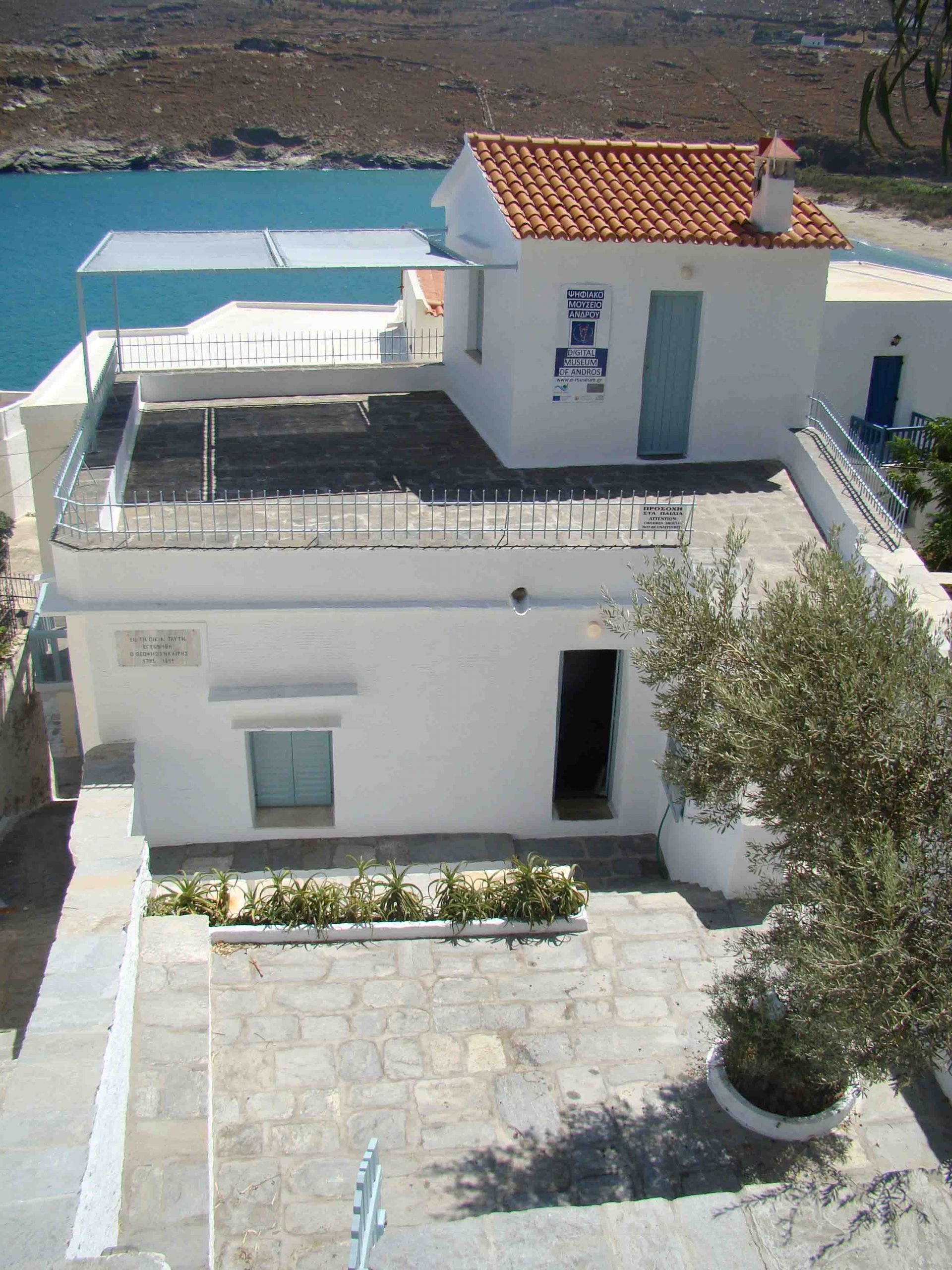
In the house of Theofilos Kairis, the Digital Museum of Andros was inaugurated relatively recently, just on Saturday, July 19, 2014.
The Digital Museum is housed in the Museum of Theophilos Kairis in Chora of Andros. To visit the Digital Museum, one crosses the main paved pedestrian street of the Chora (Agora) and continues after Kairi Square and the arch. At a distance of about 200 meters, you will find the Holy Church of Agios Georgios on your right and next to the Holy Church, towards the sea, you will see the Digital Museum of Andros.
The Digital Museum of Andros consists of a total of four rooms. In particular, from the vestibule (entrance hall), two projection rooms, one of which has the possibility of three-dimensional (3D) projections and a room for interactive applications.
A FEW WORDS ABOUT THEOFILOS KAIRIS.
Theophilos Kairis, the philosopher of modern Greece who went beyond the usual,
he followed the fate of all great thinkers who do not settle for the small and ephemeral. It is said that he was among the four giants of the spirit of his time.
The first years – Studies
He was born in Andros on October 19, 1784, the son of one of the oldest and noblest families on the island. He received his first letters in Andros, at the school of the lower castle, from the hierodeacon Iakovos, studied philosophy, mathematics, natural sciences and continued in Chios and Patmos.
In 1801 he became a monk, was ordained a Deacon, and was renamed Theophilos. In 1803 he left for Switzerland initially, at the side of Pestalozzi and studied the organization of lectures. He then ended up in Pisa, where he studied mathematics, philosophy, physics as well as physiology courses at the medical school. Later, in 1807, he went to Paris where he completed his studies in philosophy. There he was closely associated with the Greek enlightener Adamantios Korai.
His course as a Teacher
He was a very organized man, very educated, he spoke many languages (ancient Greek, Latin, Italian, French, German and English), an unimaginable size, maybe even today if he were alive he would be much ahead of us. He was fully trained and had vast knowledge. He was militant and uncompromising, brave and patriotic. It is no coincidence that in the revolution of 1821, despite the fact that he was the governor of Andros, a member of the Friendly Society, the one who gave the slogan of the Revolution on the island, he fought as a simple infantryman on Olympus, where he was wounded three times, one of these injuries were also the cause of his death.
He addressed Kapodistrias, upon his arrival in Nafplion, on January 11, 1828, and participated in the Constituent Assemblies, for the creation of the First Constitution.
In 1936, an Orphanage was opened in Andros, for the orphans of the heroes of 21 to study. He created this with money from his friends abroad, without the slightest contribution from the Greek state. The school gained a great reputation, it was even called the best at the time, and the following year many students came from the surrounding states. In his school, Kairis taught mathematics, philology, philosophy, metaphysics, ethics, rhetoric, poetry, higher mathematics, experimental physics, astronomy.
For the kingdom
In the previous period, Kairis refused to accept an honorary medal from Othon and to teach at the then newly established University of Athens, denouncing his staffing as a product of various transactions. It should be noted that Kairis was opposed to the monarchy, considering that the appointment of Otto was directly opposed to the independence of the country, probably because he lived the years after the French Revolution in Paris and was influenced by its liberal ideas. According to the writings of Sp. Trikoupis, he was an “enthusiastic patriot, Christ-like behavior, unfailingly wise, uncharitable and caring for others or for himself”.
Later, after the Constitutional Revolution of September 3, 1943 and with the help of his friend Ioannis Kolettis, he returned to Andros and continued at his school.
Kairis died in prison, from septicemia, on January 13, 1853. In a few days, the Supreme Court, with the decision of 19/19.01.1853, acquitted him of the charge, but it was too late.
Books about Kairis
Books by Theophilos Kairis that were printed are: 1) Elements of philosophy or about beings in general considered the most elementary – Athens 1851. 2) Gnostics or human knowledge a short report – Athens 1849. 3) Philosophical-philological – Patras 1875. Also ” Brief report on the immortality of the soul of the main arguments, “Cosmosophia or Catholic solidarity” – Brussels 1855. Many of his works survive anecdotes, speeches and letters.
The following are published:
1) Cognition – elements of philosophy – Introduction-edited by Nik. Sinioglu.
2) T. Kairis – From philosophical psychology to the theocratic ethics of Kazolea – Taboularis Panagiotas – Contemporary philosophy – Print.
3) Kostas Mandilas – Theofilos Kairis and the Greek Enlightenment.
4) Paschalis Dimitrios – Historical and philosophical study – print.
Also the book by Manolis Rasoulis “Theophilos Kairis the great heretic”.
In 1924 the house was bought by Michael A. Empirikos, in 1929 by Dimitrios Bonis and in 1930 it came into the hands of doctor George L. Vratsanos, who in 1944 donated it to the Holy Sepulcher. The Patriarchate of Jerusalem, at the request of distinguished Andrian scientists, finally donated the house to the Municipality of Andros to be used as a museum with memorabilia from the life of the Andrian sage.
Without any inclination to create a museum, the house for many years was used as the residence of the late Metaxas, conductor of the philharmonic, and then for other needs of the municipality.
On the occasion of a conference on the great Philosopher organized in 1984 by Dimitrios Polemis, later founder of the Kairis Library, in Andros with many foreign delegates and a donation from Vassilis and Eliza Goulandris, an exhibition on the philosopher was managed to be set up in the house.
Finally, for the first time it functioned as the “Theofilos Kairis Museum” on Saturday, August 12, 1989, and today a joint effort is being made by the Municipality of Andros and the Cairo Library to upgrade the educational role of this particular Museum, both for local and foreign visitors, as well as for school students.