

History
The liotribi operated from October to February and from 7:00 or 8:00 A.M. until 10:00 or 11:00 at night. In total they were in operation 14-16 hours a day, sometimes around the clock.
The workforce consisted of:
Three workers, the “screwdriver” and the two wives (in Andros they were usually cows).
The worker at the threshing floor was the cow operator. For his work, he was paid ¾ of an oil oka for every 20 okas produced.
The 2 screw workers who worked on the “worker” were each paid ½ oka of oil per 20 okas produced for their work.
The screwdriver – the owner of the olive mill and overseer of the whole process was “creating”, “building”, “heating” and “creating”. He worked harder than anyone. For the provision of the oil-pressing facilities and his personal labor he was paid 2 okades of oil for every 20 okades produced.
The producer of the olive fruit, therefore a “customer” of the mill, had to provide the workers (without the obligation to feed them) and the 2 sub-bales.
During the oil-pressing season, the olive mill was bustling with life. It became a place of social gathering where customers, workers, screwdriver and passing residents of the village, drinking here and there a glass, exchanged words, comments, teasing and laughter turning the hard work into a festive social event. The monotonous rhythmic sound of the screw that could be heard in public, an optimistic message of a good harvest, invited the inhabitants to join in the celebration. It worked for the production of olive oil well before 1857 until 1967.
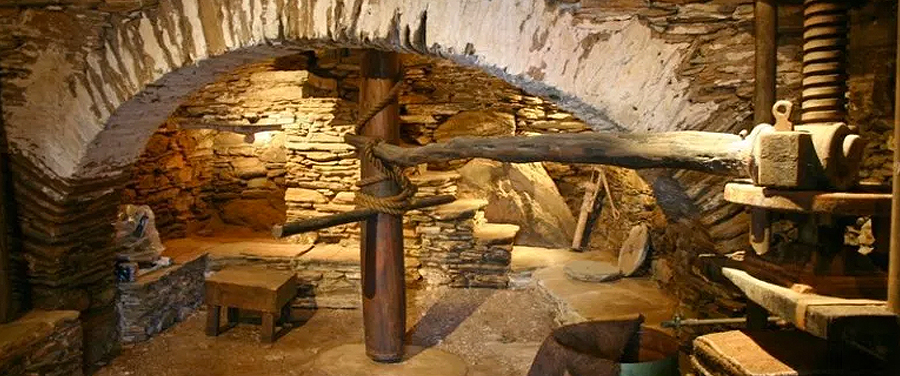
It is located in the center of the settlement, on the ground floor of an old stone-built building complex. It maintains its original equipment in its four main areas, the “boli” for crushing, the “screw” for pressing the olive fruit, etc.
It is one of the largest and most complete oil mills with animal-driven technology in Andros. The modern museum presentation (video film and plenty of teaching and informational material) relives the olive oil production processes of the traditional rural communities of Andros in past times. You can, on leaving, get books and publications that will remind you of your visit, at the same time completing the knowledge about the olive and the precious olive oil.
The museum is located on the designated hiking trail no. 9, which was the main road of communication between Chora – Batsiou – Gavrio before the opening of the provincial carriage road. Knowledge about the olive and the precious olive oil.